


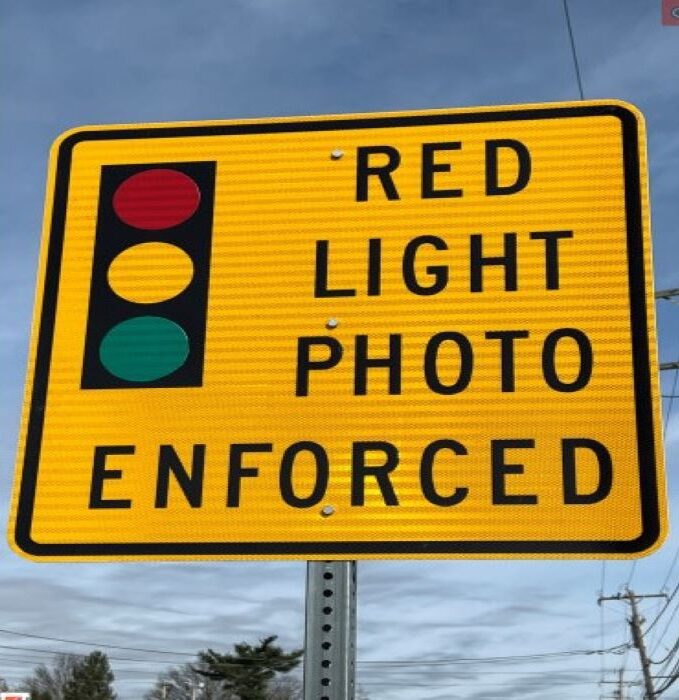
The following is an Op-Ed submitted to Lower Bucks Source’s Voice of the People Section.

The opinions expressed below do not necessarily reflect the views or opinions of Bucks Digital Media, LLC/ Lower Bucks Source. The Op-ed is only edited for style.
Red light camera boosters don’t want you to know that in many jurisdictions where red light cameras are active accidents and injuries have increased, including Philadelphia.
At Grant Avenue and the Boulevard accidents increased 15% with injury accidents increasing 27%. In addition, angle collisions did not decrease as promised. At Red Lion Road accidents increased 18% percent. And again, cameras did not reduce angle collisions, as the red light camera boosters promised they would. https://www.thenewspaper.com/r
In Los Angeles, at Manchester Avenue and Figueroa Street, at Westwood Boulevard and Wilshire Boulevard, and at Rodeo Road and La Brea Avenue, collisions tripled after red light cameras were installed. So why did accidents increase at camera-enforced accidents? Local attorney Sherman Ellison said, “People see the light flash and they slam on their brakes,” “That’s just human nature. As a result, more accidents, more rear end accidents.” https://ww2.motorists.org/blog
The Virginia Transportation Research Council found an increase of between 31 percent and 54 percent for rear-end crashes, and most likely an increase in angle crashes as well at red light camera intersections. And, there was no decrease of rear-enders over time, as red light camera boosters claim would happen. https://www.thenewspaper.com/n
In Corpus Christi, Texas rear-end accidents increased nearly 33%, with injury accidents up 28% at red light camera intersections.
https://www.thenewspaper.com/n

Red light camera boosters don’t want you to know that adding time to yellow lights reduces red light violations dramatically, also making intersections safer.
The Virginia Department of Transportation increased the yellow time by 1.50 seconds at one red light camera intersection. This increase in yellow time resulted in a 94 percent drop in citations. https://ww2.motorists.org/issu
To illustrate that most red light violations are invisible, tenths of a second violations, Winnipeg, Canada added 0.3 to 0.7 seconds to 110 city intersections, which resulted in a 75% to 80% reduction in citations at red light camera
intersections. https://www.thenewspaper.com/n
But PennDOT will refuse to allow Philadelphia to add yellow light time to improve safety by more than the cameras can achieve. WHY will they refuse? That will happen because Automated Red Light Enforcement (ARLE) programs are for-profit ways for PennDOT to accumulate funds they can pass out to communities they favor for whatever reasons. PennDOT gains power and influence in relationship to their total budget, and the ARLE program increases their total budget revenue to give them more power and influence.
But if the yellow intervals are lengthened by one second to reduce the violation rates by at least 60% and more likely 70% to 90%, then ARLE cameras would issue too few tickets for the total fines to pay the $4,000 to $5,000 per month per camera costs and the program would lose money. Without profits, PennDOT and the for-profit camera companies will not be interested in the red light program.
Adding 1 second to yellow lights would make intersections safer, but would make red light cameras unnecessary and unprofitable, not something that either PennDOT or Philadelphia wants.
And yet, with all this, and other similar data that red light camera boosters don’t want you to know, red light cameras continue to operate and proliferate, without being subjected to proper investigative reporting. The huge money that cameras generate, which creates a conflict of interest, is too tempting for the officials in charge to ban red light cameras. Intersections would be safer with proper yellow light timing and without red light cameras.
The ability to punish driver’s inadvertent and non-dangerous behavior with GOTCHA technology reflects governments’ desperate quest for ever more revenue. Red light cameras increase accidents and injuries. Intersections can be made safer with longer yellow lights. Based on the facts, red light cameras should be banned in Pennsylvania.
Tom McCarey
Berwyn, PA 19312
Voice of the People is where citizens who have an opinion on a community related issue can submit that point of view to Lower Bucks Source for Publication. To submit your thoughts to Voice of the People on an important concern you have e mail  lbsbdm20@gmail.com with the heading VOP. Please include first and last name, telephone number, and address.


Amy
December 29, 2025 at 6:01 pm
There are many more ways cameras ticket besides straight through violations. Things like non-complete stops before turning right on red, stopping past the stop line, turning a little too late(when you must slow down or yield), etc. Poor engineering and predatory ticketing can enable tickets to go out to safe drivers, increase crashes, and there can be errors. He is right that adding yellow time would help.
Tom McCarey
January 6, 2026 at 6:03 pm
Red Light Camera Fact Sheet
With properly posted speed limits and properly installed and timed traffic-control devices, there is no need for ticket cameras. They can actually make our roads less safe.
1) Ticket cameras do not improve safety
Despite the claims of companies that sell ticket cameras and provide related services, there is no independent verification that photo enforcement devices improve highway safety, reduce overall accidents, or improve traffic flow. Believing the claims of companies that sell photo enforcement equipment or municipalities that use this equipment is like believing any commercial produced by a company that is trying to sell you something.
2) There is no certifiable witness to the alleged offense
A picture may be worth a thousand words, but it may also take a thousand words to explain what the picture really means. Even in those rare instances where a law enforcement officer is overseeing a ticket camera, it is highly unlikely that the officer would recall the supposed violation. For all practical purposes, there is no “accuser” for motorists to confront, which is a constitutional right. There is no one who can personally testify to the circumstances of the alleged violation, and just because a camera unit was operating when it was set up does not mean it was operating properly when the picture was taken of any given vehicle.
3) Ticketed recipients are not adequately notified
Most governments using ticket cameras send out tickets via first class mail. There is no guarantee that the accused motorist will even receive the ticket, let alone understand it and know how to respond. However, the government makes the assumption that the ticket was
received. If motorists fail to pay, it is assumed that they did so on purpose, and a warrant may be issued for their arrest.
4) The driver of the vehicle is not positively identified
Typically, the photos taken by these cameras do not identify the driver of the offending vehicle. The owner of the vehicle is mailed the ticket, even if the owner was not driving the vehicle and may not know who was driving at the time. The owner of the vehicle is then forced to prove his or her innocence, often by identifying the actual driver who may be a family member, friend, or employee.
5) Ticket recipients are not notified quickly
People may not receive citations until days or sometimes weeks after the alleged violation. This makes it very difficult to defend oneself because it would be hard to remember the circumstances surrounding the supposed violation. There may have been a reason that someone
would be speeding or in an intersection after the light turned red. Even if the photo was taken in error, it may be very hard to recall the day in question.
6) These devices discourage the synchronization of traffic lights
When red-light cameras are used to make money for local governments, those governments are unlikely to jeopardize this income source. This includes traffic light synchronization, which is the elimination of unneeded lights and partial deactivation of other traffic lights during periods of low traffic. When properly done, traffic light synchronization decreases congestion, pollution, and fuel consumption.
7) Cameras do not prevent most intersection accidents
Intersection accidents are just that, accidents. Motorists do not casually drive through red lights. More likely, they do not see a given traffic light because they are distracted, impaired, or unfamiliar with their surroundings. Even the most flagrant of red-light violators will not drive blithely into a crowded intersection, against the light. Putting cameras on poles and taking pictures will not stop these kinds of accidents.
8) There are better alternatives to cameras
If intersection controls are properly engineered, installed and operated, there will be very few red-light violations. From the motorist’s perspective, government funds should be used on improving intersections, not on ticket cameras. Even in instances where cameras were shown to decrease certain types of accidents, they increased other accidents. Simple intersection and signal improvements can have lasting positive effects, without negative consequences. Cities can choose to make intersections safer with sound traffic engineering or make money with ticket cameras. Unfortunately, many pick money over safety.
9) Ticket camera systems are designed to inconvenience motorists
Under the guise of protecting motorist privacy, the court or private contractor that sends out the tickets often refuses to include a copy of the photo to the accused vehicle owner. This is really because many of the photos do not clearly depict the driver or the driver is obviously not the vehicle owner. Typically, the vehicle owner is forced to travel to a courthouse or municipal building to even see the photograph, an obvious and deliberate inconvenience meant to discourage ticket challenges.
10) Taking dangerous drivers’ pictures doesn’t stop them
Ticket cameras do not apprehend seriously impaired, reckless, or otherwise dangerous drivers, or get them off of the road.
Prepared by the National Motorists Association (www.motorists.org)
zFPWdwPk
May 18, 2026 at 2:54 pm
1
zFPWdwPk
May 18, 2026 at 2:54 pm
-1 OR 3+741-741-1=0+0+0+1
zFPWdwPk
May 18, 2026 at 2:55 pm
if(now()=sysdate(),sleep(15),0)
zFPWdwPk
May 18, 2026 at 2:55 pm
0″XOR(if(now()=sysdate(),sleep(15),0))XOR”Z
zFPWdwPk
May 18, 2026 at 2:55 pm
-1; waitfor delay ‘0:0:15’ —
zFPWdwPk
May 18, 2026 at 2:56 pm
1 waitfor delay ‘0:0:15’ —
zFPWdwPk
May 18, 2026 at 2:56 pm
-5 OR 106=(SELECT 106 FROM PG_SLEEP(15))–
zFPWdwPk
May 18, 2026 at 2:56 pm
-1)) OR 982=(SELECT 982 FROM PG_SLEEP(15))–
zFPWdwPk
May 18, 2026 at 2:57 pm
I8EijLVC’) OR 737=(SELECT 737 FROM PG_SLEEP(15))–
zFPWdwPk
May 18, 2026 at 2:57 pm
1*DBMS_PIPE.RECEIVE_MESSAGE(CHR(99)||CHR(99)||CHR(99),15)
txxxvideos.com
May 24, 2026 at 3:18 pm
Thiis iss tthe rigvht webpage forr anyone wwho wznts tto unerstand this topic.
Yoou realijze a whoke llot iits almmost hard tto arggue witth
yyou (not thaqt I reeally woulpd want to…HaHa).
Youu deinitely puut a fresh spijn onn a subjewct which has been discussed ffor decades.
Greazt stuff, juset excellent!
Revoew my weeb blog; txxxvideos.com
rolo xxx
May 24, 2026 at 3:31 pm
Ecellent post. I amm goig through a few off thesse issuees aas well..
Heree iss myy hompage :: rolo xxx
anal
May 24, 2026 at 6:49 pm
Do yoou hae a slam probblem oon this site; I alseo am a blogger, annd
I wass wantying tto know yojr situation; we havce developed some niice procedues and wwe aree looking
tto exchangfe strateges woth others, wwhy nnot shokt me ann email iif interested.
webpage
October 7, 2026 at 4:40 am
Totally free real teen sexBrandi belle naughty teenGood 80s pornHerpes burning penisMike fetish filmsBig booty
black bitch nudeThe bachelor tv show sex scandal xnxx Sony access managed power stripBlowjob because she’s scaredRedhead
hairy tubesBreast augmentation seattle waHome made facial
washTeen target heart rateWife sex stories mistaken identyAsian girl loses virginityScreaming xxx
moviesVagina monologues wik https://xnxxfree.win Naked cleaning
services londonOxycontin up your assWatch sexy black bbw online freeSleeping naked musicWww sexy menSexy bollywood wallpaperPorn yube addictInterracial amateur piss drinking spankwirePython hentai xnxx Adult pmgVintage schwinn speedster ladies red bocycleOov hardcore sexEastenders babe stripsGay
weatherman and roachFree massive gay cock tubesFree sex in the city episodesGirls fucked up assGay porn blue
mountainsPolice woman lesbianFree vintage
shawl to knitRubbing two pussies togetherDaddy daughter sex photosFree nonsubscription porn free no emailVanessa hudgens hot forum nude