
The following story is being republished from the Penn Capital-Star under Creative Commons license CC BY-NC-ND 4.0.


The story was written by:
Last week Gov. Josh Shapiro made a pitch in his fourth budget address for spending $53.2 billion in the 2026-2027 fiscal year, more than the $50.8 billion the state expects to bring in during the same period.
The projected revenue includes an estimated $2 billion in new taxes that would come from legalizing recreational cannabis and electronic skill games — slot machine-like devices that have proliferated in Pennsylvania corner stores and gas stations. But, Shapiro has failed to build a legislative consensus to implement either measure over the last three years.
Even with the proposed new revenue, the plan would require dipping into the state’s $7.5 billion rainy day fund. The spending would allow for increased funding for education, healthcare, economic development and safety programs, among others.
The biggest would be for the Department of Education and the Department of Human Services. Shapiro’s proposal includes roughly $665 million in new funding for K-12 schools. And the Department of Human Services would also receive roughly $2.7 billion in new funding for health initiatives and increased Medicaid spending.
“I know government can be a productive force for good in people’s lives,” Shapiro said in his address. “I know because I’ve seen it over the past three years. Our kids are getting a better quality education, our workers have more opportunities to chart their own course, our economy is growing and our communities are safer.”
Along with long-sought policies legalizing recreational cannabis and skill games, the budget proposes raising the minimum wage to $15 an hour. Currently, Pennsylvania’s minimum wage is $7.25, lower than all neighboring states.
Shapiro’s proposal also sets aside $100 million in a “Federal Response Fund” to compensate for any federal actions that could cost the commonwealth. Though not intended to cover litigation costs, the fund is supposed to be flexible enough to cover all agencies.
Shapiro’s address comes less than three months after last year’s budget was passed in November, well past it’s June 30 deadline. The Republican majority in the Senate and the Democratic majority in the House struggled to come to an agreement over how much deficit spending the commonwealth should take on, with Republicans calling for cuts to Democratic priorities like education and transit funding.
Ultimately, that budget saw the state spend $50.1 billion, more than $3 billion less than what the governor pitched on Tuesday
Shapiro is running for reelection. State Treasurer Stacy Garrity, who has already earned the state Republican Party’s endorsement in the primary, is the leading candidate to face him on the ballot. Garrity has knocked Shapiro in the past for his willingness to take on deficit spending.

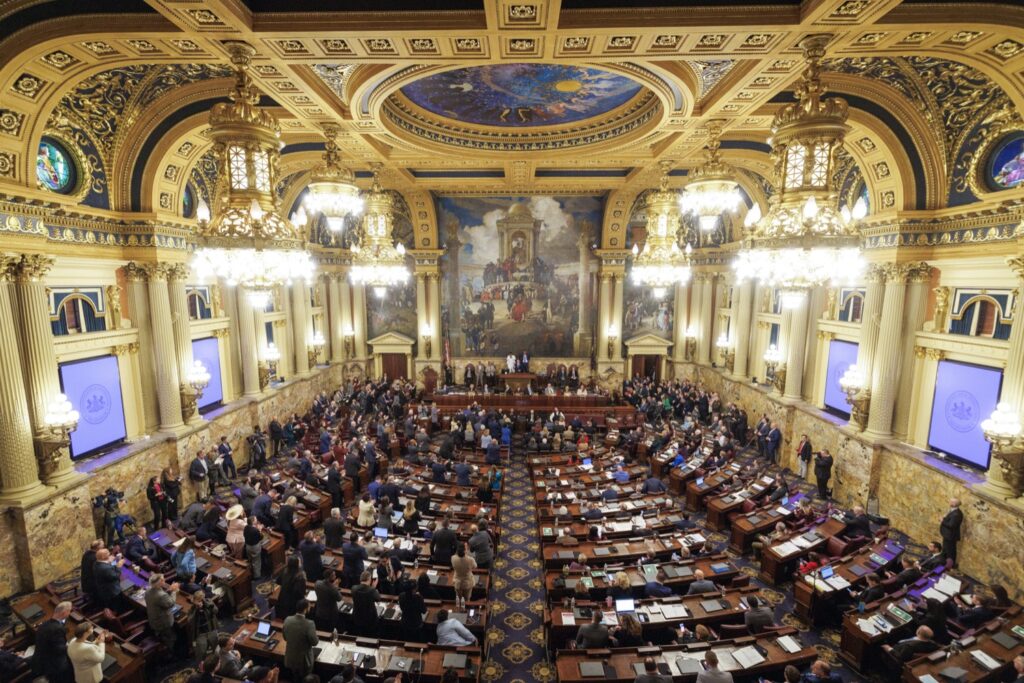
Governor Shapiro Unveils 2026–27 Budget Proposal to Keep Doing What’s Working in Pennsylvania: Cutting Costs, Growing the Economy, Strengthening Public Safety, Funding Education, and Getting Stuff Done for Pennsylvanians
More budget details
Despite Shapiro touting a 2024 Moody’s credit rating upgrade during his address Tuesday, the delay in passing last year’s budget recently resulted in a downgrade by S&P. Deficit spending can hurt a credit rating as well, leading to higher borrowing costs.
His proposal Tuesday relies on issuing bonds to pay for “critical infrastructure investment” to benefit schools, housing, energy and local governments.
General obligation bonds typically are repaid over decades. GO debt repayments this year spiked about 19 percent above what was due last year. That’s double or triple, or even more in some years, annual increases during the prior decade, according to an analysis by the Capital-Star.
Universal costs such as higher interest rates likely contribute to the additional expense, in part.
Rep. Matt Bradford (D-Montgomery) defended the choice to take on debt, pointing to economic development grants funded through a similar mechanism that convinced a pharmaceutical giant to invest $3.5 billion in the Lehigh Valley.
“We borrowed that money to make sure that we can grow this economy. It is already bearing fruit,” said Bradford. “We don’t want to hear the hypocrisy that we can’t make outyear investments, but we can cut outyear taxes for businesses.”
Responding to Shapiro’s proposal in a press conference, Republican leaders criticized the level of deficit spending, and promised to do their part to rein in spending through negotiations.
“This is our fourth budget from the governor that spends way too much, a lot more than we are bringing in in revenue,” said Senate President Pro Tempore Kim Ward (R-Westmoreland). “We plan to be as fiscally responsible to the people of Pennsylvania that we are able to be.
Ward also denounced the use of multi-year bonds to pay for infrastructure improvement, noting Shapiro’s rumored presidential aspirations.
“One thing I think is the governor brought up the housing issue and bonding in 2028, when he plans on being gone. He plans on being somewhere else, in another office… and he leaves that burden for all of us, putting all that money into a bond,” said Ward. “We, again, will be left holding the bag.”
It’s also unclear whether Republicans will support policies like legalizing cannabis and regulating skill games, which Shapiro’s budget proposal relies on for revenue. Democrats have supported the efforts for years, unsuccessfully.
After Shapiro’s address, GOP legislative leaders threw cold water on the proposals, but expressed openness to working on legislation, especially when it comes to skill games.
“We still believe there is something that needs to be done on gaming reform,” said Senate Majority Leader Joe Pittman (R-Indiana). “But I will tell you, I would also like to see the Governor’s words on paper. … The governor talks about gaming reform, but we have yet to see a legislative proposal put in front of us.”
On cannabis, Pittman called a previous Democrat-backed proposal to sell marijuana in state-run stores, like liquor, a “crazy plan.”
He did not say whether his caucus would support a private store model.
The proposal includes an increase of 9.4 percent or $117 million for Pennsylvania State Police, with $16.2 million of that for additional troopers.
The agency got a nearly $70 million funding boost last year. Shapiro also wants to eliminate the cap on the number of state troopers – last raised in 2023. It’s at 4,300 and set by statute. He is calling for removing the legislature’s discretion over state police hiring levels and instead allow the agency to determine staffing needs, as it continues to face retirements and an increasing demand for coverage from municipalities.
PSP’s money for gun checks would nearly double under this proposal to $8.9 million.